






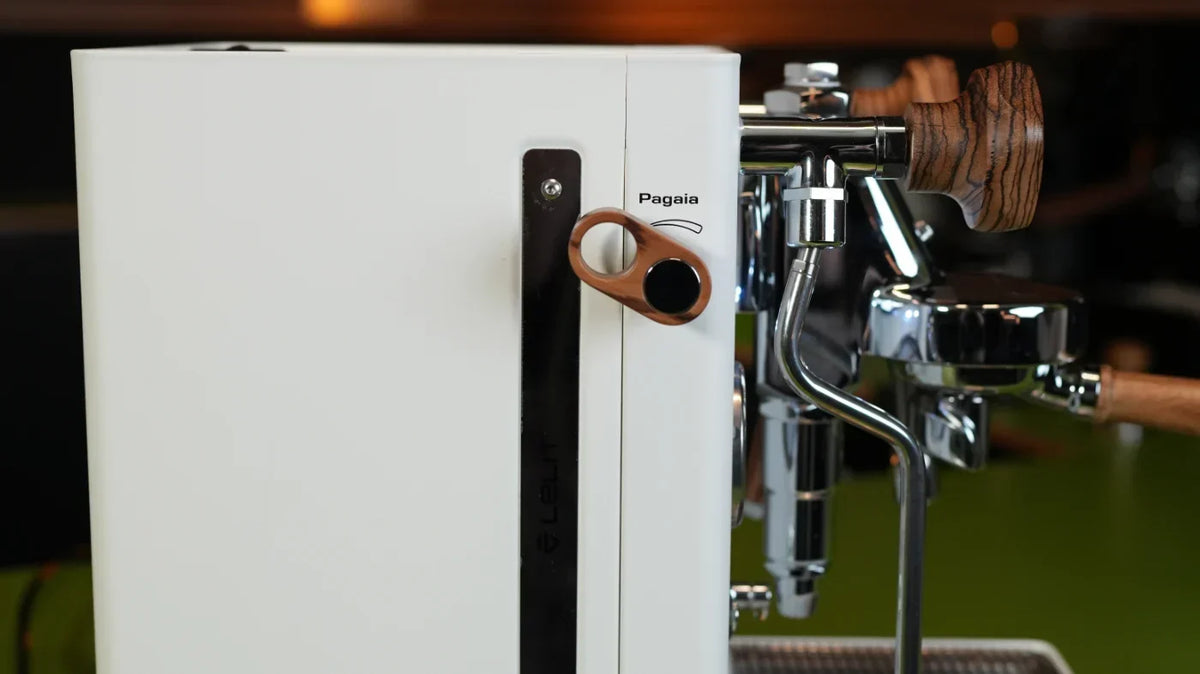

Pagaia is Italian for paddle. Lelit calls it the small lever that has allowed manual pump control during espresso extraction since the href="/en/blogs/kaffeewissen/lelit-mara-x3"Mara X3. The Mara X3 was the first machine with this control. Since October 2026, the Elizabeth 3 and Victoria 3 have also come with Pagaia, and they feature an enhanced control system: a pressure sensor and saveable pressure profiles.
On this page, we compile what we know about Pagaia: how the control works technically, what lever angle on the Mara X3 means what flow rate, and how the Elizabeth 3's control differs from the Mara X3's.
How Pagaia works technically
Classic flow control on an href="/en/blogs/kaffeewissen/faema-e61-bruehgruppe"E61 group works mechanically: a needle valve narrows the water path, the pump continues to run at full power, and the rest is throttled back. Lelit does it this way even on the href="/en/blogs/kaffeewissen/lelit-bianca"Bianca. Pagaia works differently. The lever regulates the pump's power itself, electronically and in real-time via pulse-width modulation. So instead of braking, less water is delivered from the start. The technology is based on patents from Sage, whose corporate group includes Lelit.
This has two practical consequences. First, you hear the control: at reduced flow, the vibration pump on the Mara X3 drops below 50 dB. Nice mechanical feedback that tells you more while brewing than any gauge. Second, the pressure on the Mara X3 is not a set point but a result. You control the flow, and the pressure adjusts as a consequence of the resistance in the coffee puck. If you're coming from href="/en/blogs/kaffeewissen/decent-espresso#druckprofil-vs-fliessprofil-bei-einer-espressomaschine"pressure profiling, you need to rethink here.
Mara X3: what lever angle means what flow rate
This is the question we're asked frequently. We measured it on the Mara X3:

The Pagaia lever sits on the left side of the machine. It doesn't control valve position, but rather the pump's power output.
The 10 o'clock position is a sensible starting position for pre-wetting the coffee puck because the puck gets saturated evenly there without immediately tearing href="/en/blogs/kaffeewissen/channeling"channels.
Start with the lever at 10 o'clock, wait until the first drops appear at the outlet, then turn it fully open. That's how we brewed our href="/en/products/toca-espresso"Toca espresso from Mexico: around 40 grams in just under 30 seconds. The result was caramel-like and creamy, with a long finish.
And if you don't feel like playing the game: set the lever to full flow and href="/en/blogs/kaffeewissen/espresso-zubereiten"brew classically. Pagaia doesn't force you into anything.
What Pagaia can't do on the Mara X3
Reproducibility. You brew manually, you have to develop a feel for when the puck is pre-wetted and when you turn it up. That's fun if you're into it. If you want reliably the same espresso every morning without thinking, this isn't for you. There's no volumetric dosing on the Mara X3, and there's no shot timer either.
That's exactly where the Elizabeth 3 comes in.
Elizabeth 3: lever plus saveable pressure profiles
The Elizabeth 3 has the same basic mechanism—the pump is also controlled via pulse-width modulation here. Added to that is a pressure sensor that measures during extraction how much resistance the coffee puck exerts on the pump. The display shows the pressure on the coffee and the selected profile during extraction. This allows the Elizabeth 3 to work in two distinct ways.
You run pressure profiles via the buttons. Each of the two extraction buttons saves a profile with up to five stages. For each stage, you set the pressure in half-bar increments and the duration. Unlike on the Mara X3, you specify a pressure here, and the machine regulates the pump to reach it. In our testing, for example, we selected eight seconds at 3 bar for pre-wetting and then 8.5 bar for the remaining 17 seconds. If you like, you can create a lever profile with all five stages that goes up to 9 bar and then drops a bar every few seconds.
You control manually via the lever. With the Pagaia, you start the extraction directly on the side and regulate the pump during extraction, just like on the Mara X3. This is handy when you want to try a recipe or when a shot goes off the rails. In our testing, an extraction ran too fast toward the end. We used the lever to brake and landed at 22 to 23 seconds; at 9 bar, the coffee would probably have been done in 19 seconds.
On the Mara X3, you control the flow exclusively by hand; nothing is saved. On the Elizabeth 3, saveable pressure profiles and the lever are two separate paths. If you start via a button, you can't switch to the lever in the middle of extraction, and the lever can't be combined with a saveable profile. The buttons also work with time control, which the Mara X3 lacks. Neither machine has volumetric dosing.
How well this works in the cup depends less on the Elizabeth 3's control than on the temperature. After 20 minutes, the first extraction at a set 94 °C is at 93.6 °C. The temperature drops by about 2 degrees per minute over five extractions, but with two minutes of pause between extractions, it stays within 0.9 degrees. All measured values, the programming step by step, and our recipe are in the href="/en/blogs/kaffeewissen/lelit-elizabeth-3"Lelit Elizabeth 3 test.
Which Lelit has which Pagaia configuration level
| Machine | Type | Lever | Pressure sensor with display | Saveable profiles | Dosing |
|---|---|---|---|---|---|
| href="/en/blogs/kaffeewissen/lelit-mara-x3"Mara X3 (PL62X3) | href="/en/blogs/kaffeewissen/zweikreiser-espressomaschinen-vergleich"Double boiler | Yes, regulates flow | No | No | Manual |
| href="/en/blogs/kaffeewissen/lelit-elizabeth-3"Elizabeth 3 | href="/en/blogs/kaffeewissen/dualboiler-espressomaschinen-tests"Dual boiler | Yes, only without saveable profile | Yes | 2 buttons, up to 5 pressure stages each | Time control |
| Victoria 3 | href="/en/blogs/kaffeewissen/einkreiser-espressomaschinen"Single boiler | Yes | Yes, according to Lelit | Programmable pressure profiles, according to Lelit | Not yet verified |
We tested the Mara X3 (50.2 out of 100 points) and the Elizabeth 3 (61.7 out of 100 points). The information about the Victoria 3 comes from Lelit and has not been measured.
What does Pagaia cost
In Brussels, we were told of a 300 euro surcharge for the Elizabeth and Victoria compared to the version without the lever. This can't be reconciled with the prices at market launch. The Elizabeth 3 costs 1,649 euros in stainless steel and 1,699 euros in black or white; the Victoria 3 costs 1,149 and 1,199 euros according to Lelit. The Elizabeth PL92T without Pagaia is available today for around 1,000 euros. The Mara X3 has Pagaia built in; the price there is 1,699 euros, around 500 euros more than its predecessor.
Lelit machine prices have been heavily discounted by major international retailers in recent years. Machines were sometimes 200 to 400 euros below MSRP. We'll see where the machines with Pagaia settle.
Why Lelit can do this now
Lelit has been part of the Breville Group since 2022, which is the company that operates as href="/en/blogs/kaffeewissen/sage-oracle-jet-test"Sage in Europe. We were told in Brussels that there's a large patent portfolio there that Lelit can draw from. After years in which we've made href="/en/blogs/kaffeewissen/woc-genf-2025"jokes about trade shows about new paint jobs as innovation, technologies are finally coming together visibly here.
Conclusion
Pagaia is not a gimmick. On the Mara X3, we had genuine flow profiling in a classic double boiler, and it was a joy. With the Elizabeth 3, Lelit takes a step further: there are saveable pressure profiles in a price range where this didn't exist before, plus the lever for manual extractions.
The limitations on both machines lie less in the control than in the temperature. The Mara X3's temperature consistency failed the stress test; the Elizabeth 3's small brew boiler loses about 2 degrees with many consecutive extractions. It will be particularly interesting with the Victoria 3 as a single boiler with a small boiler to see whether gentle pre-infusion takes place within a stable temperature window. The Victoria 3 is on our list.
Further reading: our href="/en/blogs/kaffeewissen/lelit-elizabeth-3"Lelit Elizabeth 3 test, our href="/en/blogs/kaffeewissen/lelit-mara-x3"Lelit Mara X3 test with all measured Pagaia values, our href="/en/blogs/kaffeewissen/lelit-elizabeth"Lelit Elizabeth PL92T test, and our href="/en/blogs/kaffeewissen/lelit-victoria-test-und-tipps"Lelit Victoria test. You'll find an overview of all Lelit machines on our href="/en/blogs/kaffeewissen/lelit"Lelit page. How we test is explained in our href="/en/blogs/kaffeewissen/espressomaschinen-testprotokoll"test protocol.


